Original Publication DATE: 11/7/2012
A sequence of five elevated marine terraces along Jug Handle Creek in coastal Mendocino County constitutes a nationally and internationally famous ecological staircase. So outstanding is the combination of canyons, terraces and ancient dunes, tall redwoods and firs, bishop pine forest and dwarfed pines and cypresses that…It has become a Mecca for naturalists, botanists, ecologists, pedologists (soil scientists), geographers and nature-oriented laymen. It is being praised as the best preserved ecological showplace of coastal landscape evolution anywhere in the northern hemisphere.
–Hans Jenny 1973
Throughout the Pleistocene, repeated climate shifts caused sea levels to rise and fall as the polar ice sheets expanded and retreated. During periods of stable sea level, waves carved broad marine terraces along the coast. Over time, tectonic uplift slowly raised these terraces above the ocean, creating the remarkable landscape seen today in Mendocino County. As soil scientist Hans Jenny observed, this is the finest preserved example of coastal landscape evolution in the Northern Hemisphere.
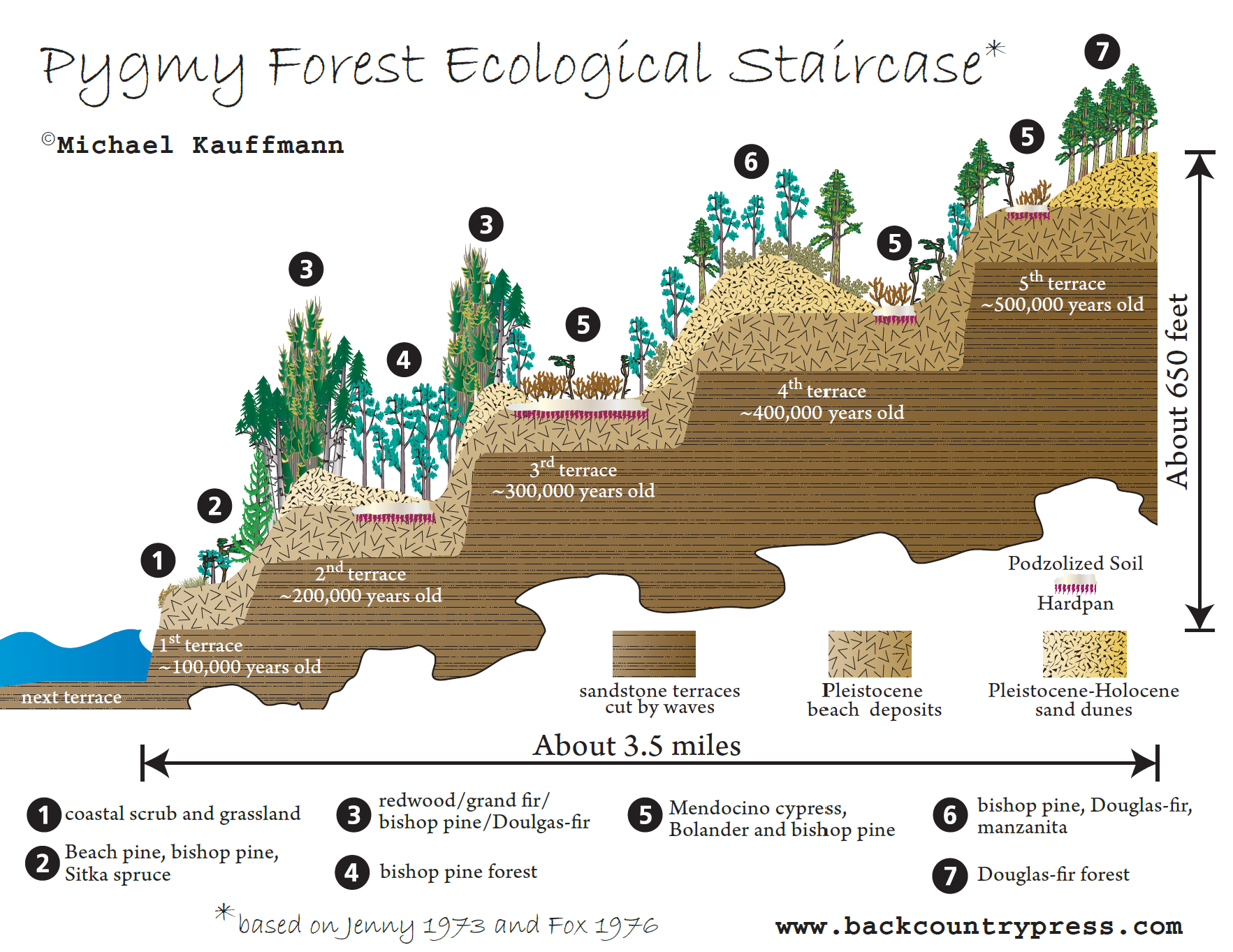
As the terraces formed, waves, wind, and streams deposited layers of sand, gravel, clay, and other sediments of varying depths across the landscape. Along the youngest terrace nearest the Pacific, salt-laden winds shape coastal bluffs into grasslands, scrub, and the wind-pruned “bonsai” forests of bishop pine. Farther inland, beyond the reach of ocean spray, abundant rainfall, ancient Pleistocene and Holocene dunes, and the steady accumulation of nutrient-rich conifer needles create ideal conditions for towering forests with deep roots and lofty canopies. Yet the staircase’s most remarkable story begins just east of these ancient dunes.
Continue reading “The Ecological Staircases of Mendocino County”