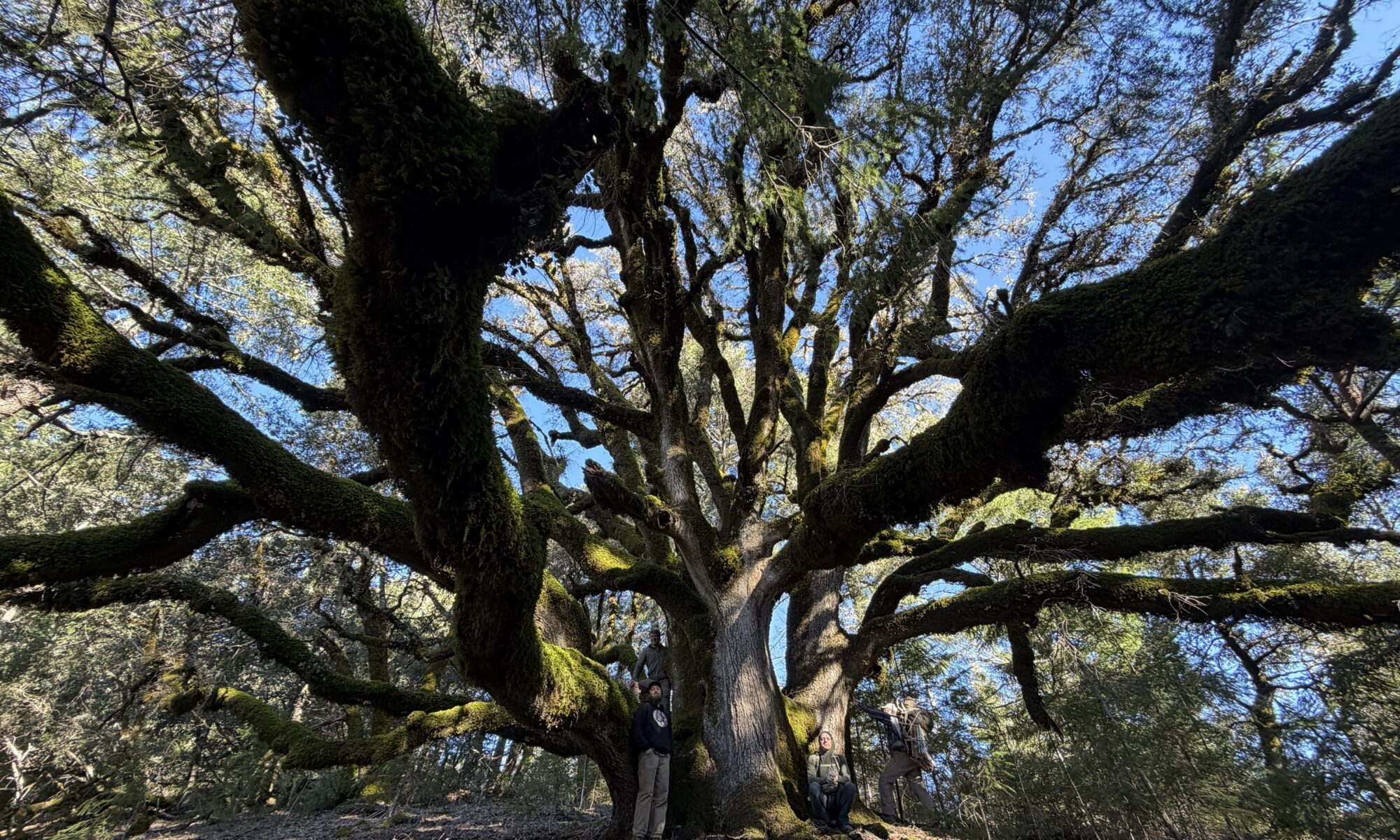

Some trees you pass. Others slow you down.
The Iaqua Oak is an old one—a living expression of time in the Humboldt County hills, just inland from a coast defined by towering redwoods.
I recently visited this tree because I care deeply about old ones. While there, I mapped it using the Polycam app on my iPhone, capturing LiDAR data that begins to tell its story in another way. By measure alone, it commands attention: 34’8″ in circumference, 57 feet tall, with an 80-foot crown spread—totaling 493 American Forests points. One of the largest known canyon live oaks (Quercus chrysolepis), its massive limbs carry centuries of growth, disturbance, and survival. But like many of our largest trees, it is beginning to decline.
Historian Jared Farmer reminds us that trees like this belong to our elderflora—beings that hold time not just in rings, but in relationships. Standing beneath this oak, you feel that depth in its ecology and contributions to human cultural.
Long before us, the Nongatl, Wiyot, and Whilkut people moved through this landscape. A tree like this—distinct, enduring—likely served as a landmark, a guidepost in a lived geography of memory and movement. But, something is shifting.
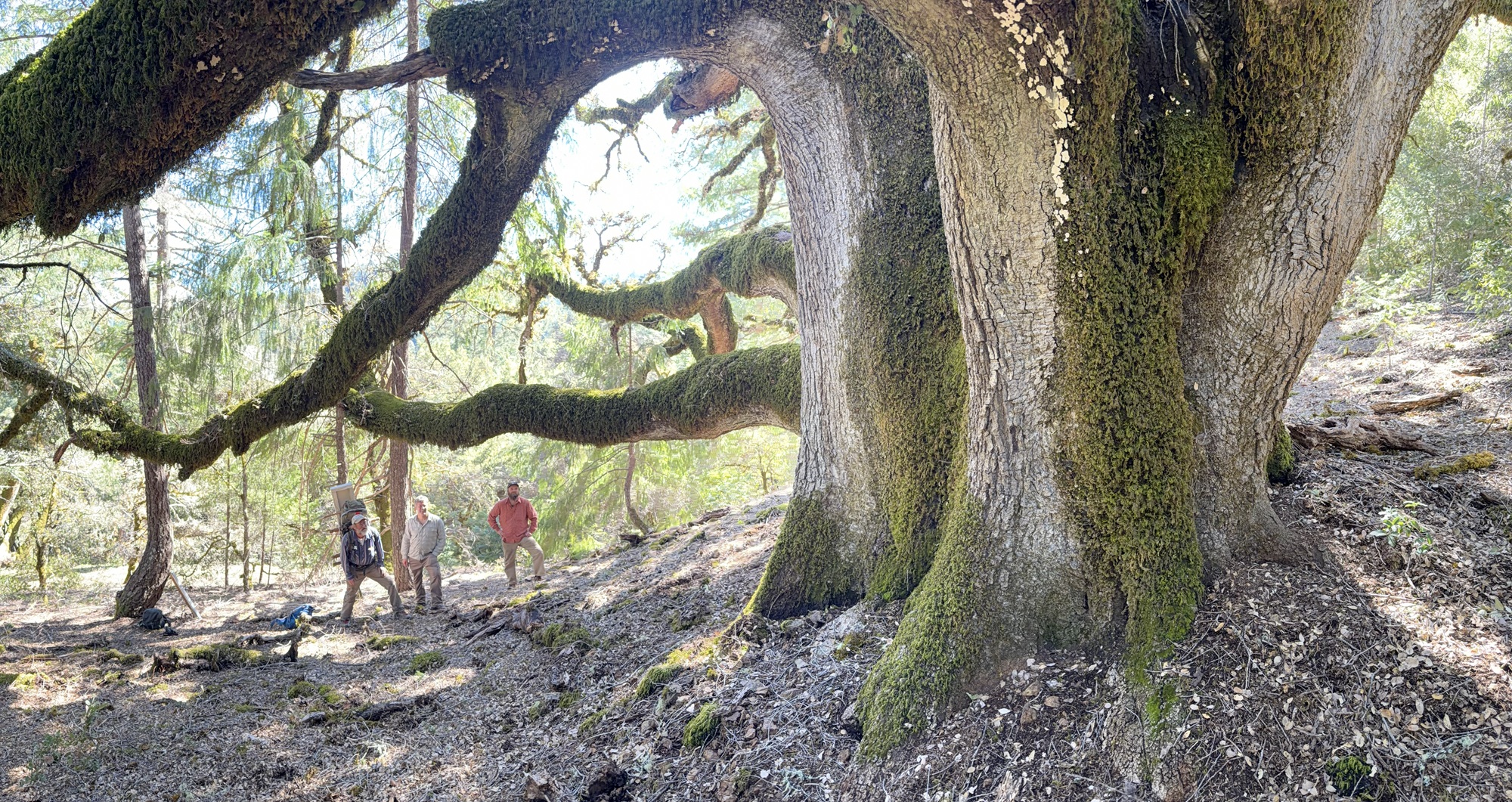
Across California, forests are growing younger. Not fewer trees—but fewer old ones. The richness of age—chronodiversity—is thinning. The Iaqua Oak reflects this change: a canopy pulling inward, branch tips retreating, a slow unwinding shaped by heat, drought, and time.

Not all big trees are old—but the old ones matter differently. They anchor ecosystems, stretch our sense of time, and remind us that longevity is not an accident, but a condition that must be allowed.
The Iaqua Oak is in decline. After more than a century of fire suppression, Douglas-firs have filled in around it, slowly crowding its crown and changing the conditions it once grew within. I’ve connected with the landowner, and there is hope we can reduce fuels and open space around the tree—giving it a little more light, a little more time. It is a small act, but small acts accumulate. They always have.
With thoughtful fuels reduction—and, ideally, the return of fire—somewhere nearby, a young tree is growing. It casts only a modest shadow, easy to overlook. But it may become what Farmer calls the future oldest tree: already alive, already rooted, its full story shaped by what we choose to do now.
We cannot keep every old tree. Many are already slipping beyond our reach. But our legacy is not only what we lose—it is what we protect, and what we choose to tend.
To keep the future oldest tree alive, we must do two things at once:
Hold onto the old ones—giving them space, reducing pressures, honoring their role in the landscape
Make room for the next ones—allowing trees to grow slowly, fully, and without interruption
Spending time with trees—measuring them, circling their trunks, tracing their form with tools and hands—is one way we enter that continuum. The act itself is simple, but it asks something of us: to slow down, to pay attention, to stand long enough beside another living being that time begins to stretch. In measuring a tree, we are not just recording dimensions—we are, in a small way, learning how to be present with something older than ourselves.
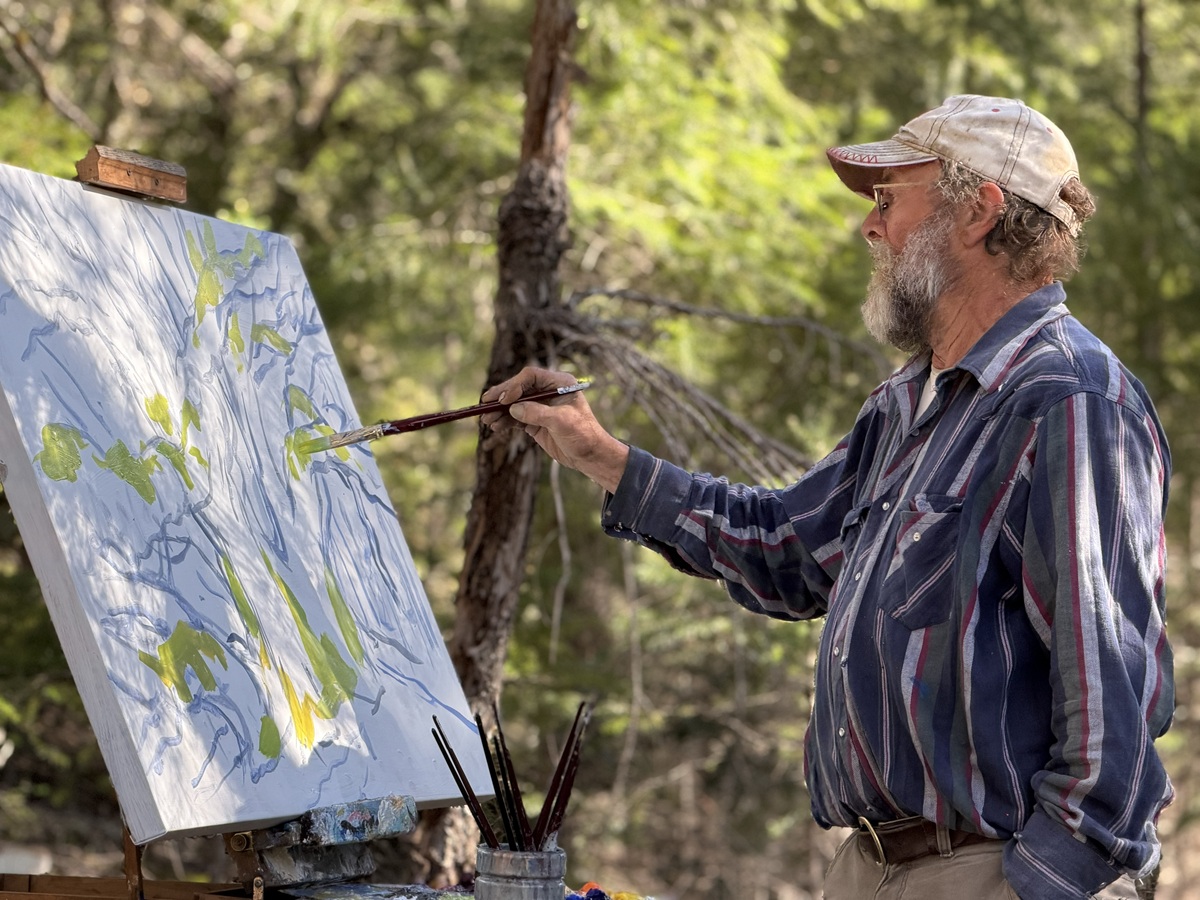
The Iaqua Oak stands in that threshold between past and future.
It may not endure another four centuries. But if we listen closely, it offers something just as enduring: a way of thinking that stretches beyond our own time.
We must spread the words of the importance of all the old ones living among us, including those under our feet – the elder mycelia that bind and nurture the elder flora. See “Entangled Life” by Merlin Sheldrake. To ignore elder life is to jeopardize life itself on earth.
♥
Thank you to the sun that has always shined on this tree. To the water and nourishing nutrients that have bathed its root. To the squirrels and pollinators. I send up all my gratitude to the whole of everything that miraculously supports such extraordinary expressions of life. Our lives. All lives.
Caring for the tree means caring for all of it. Grateful you shared this.
That individual is older than 400 years (or whatever a ring count of the current stems indicates). The multi-trunk growth form results from a set of crown sprouts from a prior root-crown, most likely following top-kill by a previous fire. This individual is genetically continuous with the prior stem and the still-living root system. Many oak species sprout prolifically following top-kill. often resulting in ‘multi-stemmed’ trees (garry oaks throughout the Klamath ecoregion providing a good example); the lives of old oak trees/clones are continuous across multiple periods of ecological change.
Chad – That’s a great perspective—and one I hadn’t fully considered.
It’s incredible to think of this tree as a continuous life across generations of stems, shaped by fire and renewal rather than defined by a single trunk. The idea that it has endured repeated disturbance—and even thrived because of it—adds a whole new layer to its story.
The importance of “making room” for next old ones cannot be understated. As we in British Columbia work to preserve the last of our ancient trees in Old Growth Management Areas (OGMA’s), the setting aside “recovery areas”, where the productive low valley sites become the nurseries for the next many generations.